

How Peer Review Works in Academic Conferences (Complete Beginner's Guide)
Introduction
If you've ever submitted a research paper to an academic conference, you've encountered peer review — the process that determines whether your work gets accepted, revised, or rejected. But if you're new to academia, the entire process can feel like a black box. You submit your paper, wait weeks (sometimes months), and eventually receive a decision along with feedback from anonymous reviewers. What actually happens during that waiting period?
Peer review is the backbone of academic quality control. It's the mechanism through which the research community ensures that published and presented work meets standards of rigor, originality, and significance. Without it, conferences would have no reliable way to distinguish groundbreaking research from poorly designed studies or recycled ideas.
But peer review isn't just about gatekeeping. At its best, it's a collaborative process that improves the quality of research. Constructive reviewer feedback helps authors strengthen their methodology, clarify their arguments, and situate their work within the broader literature. It's one of the few mechanisms in academia where experts voluntarily invest their time to help other researchers — even anonymously.
In this guide, we'll break down exactly how peer review works in academic conferences — step by step. Whether you're a graduate student preparing your first submission, a new reviewer wondering what's expected of you, or an organizer designing your review process, this guide will give you a clear, practical understanding of the entire system.
What is Peer Review?
Peer review is the evaluation of academic work by independent experts (peers) in the same field. In the context of academic conferences, peer review is the process by which submitted research papers are assessed for quality, originality, methodology, and relevance before being accepted for presentation. Reviewers — typically researchers with expertise in the paper's topic — provide structured feedback and recommendations that inform the program committee's accept or reject decisions.
Quick Summary
- Peer review is how academic conferences evaluate submitted research before acceptance
- The three main types are single-blind, double-blind, and open review — each with distinct trade-offs
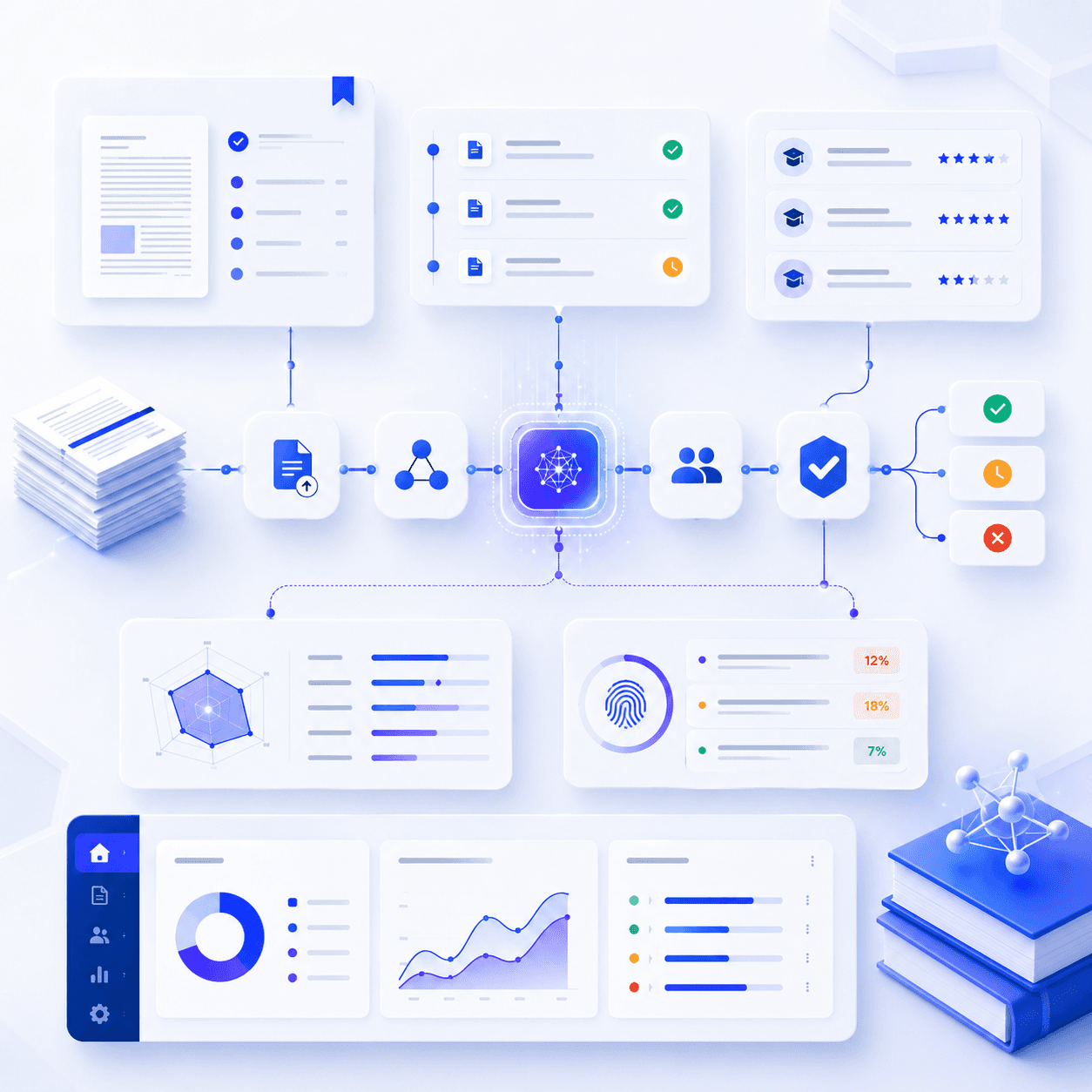
- The workflow follows a structured pipeline: submission → screening → assignment → review → decision → notification
- Reviewers evaluate papers for novelty, methodology, clarity, and ethical standards
- Common problems include reviewer bias, delays, inconsistency, and workload overload
- AI tools are improving peer review through automated paper analysis, smart reviewer matching, and similarity detection
- Modern platforms like Confairo integrate AI directly into the review workflow to support — not replace — human judgment
What is Peer Review in Academic Conferences?
Peer review in academic conferences is a structured evaluation process where submitted research papers are assessed by qualified experts before being accepted for presentation or publication in conference proceedings.
Unlike journal peer review — which can take months or even years and often involves multiple rounds of revision — conference peer review typically operates on a compressed timeline. Most conferences complete their entire review cycle in 4–8 weeks, from submission deadline to decision notification. This creates both urgency and constraints: reviewers have less time per paper, and there's usually only one round of review with no revision opportunity.
The Purpose of Conference Peer Review
Conference peer review serves several interconnected purposes:
- Quality control — Ensuring that accepted papers meet minimum standards of academic rigor, methodological soundness, and writing quality
- Originality verification — Confirming that the work represents a genuine contribution to the field, rather than a rehash of existing research
- Relevance filtering — Verifying that submissions align with the conference's scope and themes
- Constructive improvement — Providing authors with expert feedback that helps them strengthen their work, regardless of the accept/reject outcome
- Academic credibility — Establishing the conference's reputation as a venue that presents vetted, high-quality research
Without peer review, a conference is essentially an open-mic event — anyone can present anything. Peer review transforms it into a curated academic program where attendees can trust that the presented research has been evaluated by experts. For a broader view of how peer review fits into the conference lifecycle, see our complete conference management guide.
Why Peer Review is Important
Peer review is more than an administrative step — it's a foundational mechanism that protects the integrity of academic knowledge. Here's why it matters:
Academic Integrity
Peer review acts as a safeguard against fraudulent, fabricated, or misleading research entering the academic record. Reviewers check whether claims are supported by evidence, whether data appears authentic, and whether the methodology could reasonably produce the reported results. While no system is perfect, peer review catches a significant proportion of problematic work before it reaches the public stage.
Fairness and Equal Opportunity
A well-designed peer review process evaluates research on its merits — not on the reputation of the author's institution, their career stage, or their geographic location. Double-blind review, where both authors and reviewers are anonymous, is specifically designed to minimize these biases. When the system works as intended, a brilliant paper from a first-year PhD student at a small university receives the same evaluation standard as one from a senior professor at a prestigious institution.
Quality Assurance for Attendees
Conference attendees — researchers, practitioners, students — invest time and money to participate. They expect that the papers being presented have been vetted for quality. Peer review is what separates a credible academic conference from an unfiltered content dump. It's the quality signal that makes the event worth attending.
Constructive Feedback Loop
Even rejected papers benefit from peer review. Thoughtful reviewer feedback identifies weaknesses in methodology, gaps in the literature review, unclear writing, or unconvincing arguments. Authors can use this feedback to improve their work before submitting to another venue. This feedback loop is one of the most valuable — and most underappreciated — aspects of the peer review system.
Types of Peer Review
Not all peer review processes are the same. The level of anonymity between authors and reviewers varies, and each model carries different trade-offs. Here are the three primary types used in academic conferences:
1. Single-Blind Review
How it works: Reviewers know the identity and affiliation of the authors, but the authors do not know who reviewed their paper.
| Aspect | Detail |
|---|---|
| Pros | Reviewers can consider the author's track record and context; simpler to administer |
| Cons | Risk of prestige bias — papers from well-known researchers or top institutions may receive more favorable reviews regardless of quality |
| Common in | Some engineering and applied science conferences |
2. Double-Blind Review
How it works: Both the authors and the reviewers are anonymous to each other. Authors must remove identifying information from their submissions (names, affiliations, self-citations that reveal identity).
| Aspect | Detail |
|---|---|
| Pros | Minimizes bias based on author reputation, institution, or demographics; promotes evaluation based purely on research quality |
| Cons | Perfect anonymity is difficult to achieve — experienced reviewers can often guess authorship from writing style, topic, or cited work; adds administrative complexity for anonymization |
| Common in | Most major CS, AI, and social science conferences (NeurIPS, CVPR, ACL, CHI) |
3. Open Review
How it works: Both authors and reviewers are identified, and reviews may be made publicly available. Some open review systems also allow community members (beyond assigned reviewers) to comment on submissions.
| Aspect | Detail |
|---|---|
| Pros | Increases accountability — reviewers are less likely to write dismissive or lazy reviews when their name is attached; promotes transparency and community discussion |
| Cons | Junior reviewers may hesitate to criticize senior researchers; potential for social pressure to influence reviews; risk of retaliation |
| Common in | ICLR (via OpenReview.net), some interdisciplinary workshops |
Which type is best? There's no universal answer. Double-blind is the most widely used in competitive conferences because it prioritizes fairness. Open review is gaining traction in communities that value transparency. The right choice depends on your conference's culture, size, and goals.
Step-by-Step Peer Review Workflow
Regardless of the review type, most academic conferences follow a similar structured workflow. Here's the complete pipeline from submission to final acceptance:
Step 1: Paper Submission
Authors submit their research papers through the conference's submission portal before the published deadline. Submissions typically include the paper (PDF), title, abstract, keywords, author information, and track selection. A good submission system sends automatic confirmation emails and allows authors to update their submission until the deadline closes. This eliminates the chaos of email-based submissions that plagues many conferences — a problem we cover in detail in our guide on common conference management mistakes.
Step 2: Initial Screening
Before papers reach reviewers, the program chair or organizing committee performs an initial screening. This desk review checks for basic compliance: Does the paper follow the required format? Is it within the page limit? Is it anonymized correctly (for blind review)? Is it within the conference's scope? Papers that fail basic requirements may be desk-rejected at this stage, saving reviewer time for papers that meet the minimum bar.
Step 3: Reviewer Assignment
This is one of the most critical — and most challenging — steps. The program chair must match each paper with 2–3 qualified reviewers who have relevant expertise, no conflicts of interest, and balanced workloads. Traditional manual assignment involves reading abstracts and cross-referencing reviewer profiles — a process that can take days for a medium-sized conference. Modern platforms use keyword-based or AI-powered matching to dramatically accelerate this step while improving match quality.
Step 4: Review Phase
Assigned reviewers read the papers and submit their evaluations through a structured review form. Typical review forms ask reviewers to rate the paper on dimensions like novelty, technical soundness, clarity of writing, significance of contribution, and adequacy of evaluation. Reviewers also provide written comments — both for the authors and confidential notes for the program committee. This phase typically lasts 2–4 weeks, with automated reminders sent to reviewers as the deadline approaches.
Step 5: Decision Making
Once reviews are collected, the program committee meets to make final accept/reject decisions. For papers where reviewers agree, the decision is usually straightforward. For papers with conflicting reviews (one strong accept and one reject), the committee may assign a meta-reviewer or engage in discussion to reach a consensus. Some conferences use area chairs to manage subsets of papers and provide meta-reviews that synthesize the individual reviews.
Step 6: Author Notification
Authors receive their decision along with the reviewer feedback. A well-run conference provides detailed, constructive feedback regardless of the outcome — helping authors understand exactly why their paper was accepted or rejected and what they can improve. Automated notification systems ensure that every author receives their decision simultaneously, maintaining fairness and reducing the organizer's email burden.
Step 7: Camera-Ready Submission
Authors of accepted papers submit their final, camera-ready versions — incorporating any required revisions based on reviewer feedback. This version is what appears in the conference proceedings. The camera-ready phase typically has a tight deadline (1–2 weeks) and strict formatting requirements.
Responsibilities of Reviewers
Being a peer reviewer is one of the most important service roles in academia. Reviewers are the human engine that powers the entire system. Here's what good reviewing looks like:
Evaluating Novelty and Contribution
The primary question: Does this paper contribute something new to the field? Reviewers assess whether the research question is original, whether the approach is novel, and whether the findings advance understanding beyond what's already published. This requires the reviewer to be familiar with the current state of the art — which is why expertise-based assignment is so critical.
Checking Methodology
Sound methodology is non-negotiable. Reviewers examine whether the research design is appropriate for the claims being made, whether the experimental setup is rigorous, whether the data analysis is correct, and whether the results actually support the conclusions. A paper with interesting ideas but flawed methodology should not pass review.
Providing Constructive Feedback
The best reviewers don't just identify problems — they suggest solutions. Instead of "the evaluation is weak," a constructive reviewer writes: "The evaluation would be significantly strengthened by including comparison with [specific baseline] and reporting [specific metric]." This kind of feedback transforms peer review from a judgment mechanism into a mentoring opportunity.
Upholding Ethical Standards
Reviewers are expected to maintain confidentiality (never sharing or discussing submissions), declare conflicts of interest, evaluate work objectively regardless of personal relationships, and flag any suspected ethical violations (fabricated data, undisclosed conflicts, plagiarism). These ethical obligations are what make peer review trustworthy.
Common Problems in Peer Review
Despite its importance, peer review is far from perfect. Understanding its weaknesses is essential for improving it.
Reviewer Bias
Even in double-blind review, biases can creep in. Reviewers may unconsciously favor papers from prestigious institutions (when anonymization is imperfect), prefer research that aligns with their own methodological approach, or be harsher toward work in subfields they personally consider less important. Systemic biases — geographic, linguistic, and demographic — are well-documented in the peer review literature.
Delays and Missed Deadlines
Reviewers are volunteers with their own research, teaching, and administrative responsibilities. Late reviews are endemic in academic conferences, often causing cascading delays that push back decision notifications, camera-ready deadlines, and ultimately the conference schedule itself. Without automated tracking and reminders, organizers spend disproportionate time chasing overdue reviews.
Inconsistent Review Quality
The quality of reviews varies enormously. Some reviewers write detailed, multi-page assessments with specific, actionable feedback. Others submit three sentences that could apply to any paper in the field. When one reviewer writes a thoughtful critique and another submits a superficial assessment, the program committee is left with an uneven information base for decision-making.
Reviewer Overload
The volume of academic submissions is growing faster than the reviewer pool. Top conferences receive thousands of submissions, and the same pool of qualified reviewers is stretched across multiple venues. Reviewer fatigue leads to rushed evaluations, declining acceptance rates for review invitations, and an increasing burden on the researchers who do agree to serve. This is a systemic problem that modern conference management tools are specifically designed to address through workload balancing and automation.
How AI is Improving Peer Review
The challenges described above — bias, delays, inconsistency, overload — are not just complaints. They're structural problems that scale with the growth of academic research. And they are precisely the problems that AI is beginning to solve, not by replacing human reviewers, but by augmenting their capabilities and removing bottlenecks from the workflow.
AI Paper Reviewer Assistant
One of the most impactful AI applications in peer review is the automated paper analysis assistant. Rather than a reviewer starting from scratch with a blank review form, an AI assistant can read the submitted paper and generate a structured pre-analysis within seconds — identifying the paper's core contribution, methodological approach, potential strengths, possible weaknesses, and writing quality indicators.
This doesn't write the review. What it does is give the reviewer a structured starting point — a preliminary map of the paper that highlights areas worth closer attention. The reviewer then applies their domain expertise to evaluate the aspects that AI can't assess: the significance of the research question, the validity of the experimental design in context, and the broader implications for the field. The result is more thorough, more consistent reviews completed in less time.
Platforms like Confairo integrate this capability directly into the reviewer dashboard. A reviewer clicks a single button and receives an AI-generated analysis alongside the paper — summary, identified strengths and weaknesses, grammar assessment, and a preliminary confidence-scored recommendation. It's designed as decision support, not a decision maker.
Smart Reviewer Assignment
Traditional reviewer assignment relies on keyword matching and the program chair's personal knowledge of the reviewer pool. AI-powered assignment systems go deeper — they analyze the full semantic content of each submission and match it against reviewer expertise profiles built from declared interests, publication history, and past review assignments.
The practical difference is significant. Instead of a paper about "federated learning for healthcare data" being assigned to anyone who listed "machine learning" as a keyword, an AI system can match it to a reviewer who specifically works on privacy-preserving distributed computing in clinical settings. Better matches produce better reviews — more substantive feedback, more accurate assessments, and fewer instances of reviewers evaluating papers outside their genuine expertise.
Confairo's smart assignment system generates ranked reviewer suggestions with relevance scores and automatic conflict-of-interest detection, reducing the assignment process from days of manual work to minutes of informed decision-making. For more on how AI is transforming conference workflows, see our detailed article on AI in academic conference management.
AI Similarity Detection
Traditional plagiarism detection compares text against databases using lexical matching — it catches copy-paste but misses paraphrased content, structural similarity, and conceptual overlap. AI-powered similarity detection uses language models trained on academic literature to identify multiple layers of overlap: direct text matches, paraphrased content that retains the same structure and meaning, and papers that follow suspiciously similar organizational patterns.
For conference organizers, this serves as an early quality gate. Rather than discovering originality issues during peer review — or worse, after acceptance — AI similarity detection flags potential concerns at the submission stage. A paper with 5% similarity is routine; a paper with 40% similarity warrants immediate attention. This gives organizers actionable intelligence before the review process even begins.
Confairo's built-in similarity detection runs automatically on submitted papers, providing organizers with a quantified similarity score and a detailed breakdown of flagged sections — all within the same dashboard they use for managing submissions and reviews.
Best Practices for Organizers
If you're organizing a conference and designing your peer review process, here are actionable practices that lead to better outcomes:
- Use structured review forms — Don't give reviewers a blank text box. Provide specific evaluation criteria (novelty, methodology, clarity, significance) with rating scales and dedicated comment sections for each dimension
- Set clear reviewer guidelines — Provide explicit instructions on what constitutes a good review, including expected length, tone, and the importance of constructive feedback even for rejected papers
- Assign 3 reviewers per paper minimum — Two agreeing reviewers provide a reliable signal. A third reviewer breaks ties and adds perspective. This is the minimum for defensible decisions
- Use automated deadline reminders — Don't rely on manual follow-ups. Configure automated reminders at 7 days, 3 days, and 1 day before the review deadline. This alone can reduce late reviews by 40–60%
- Balance reviewer workloads — No reviewer should be assigned more papers than they can thoroughly evaluate. A common target is 3–5 papers per reviewer per conference, depending on paper length and review depth
- Detect conflicts of interest systematically — Don't rely on self-reporting alone. Use automated conflict detection based on co-authorship history and institutional affiliations
- Provide feedback with every decision — Even rejected papers should receive constructive feedback. Authors who receive helpful feedback are more likely to submit improved work to your next conference
- Leverage AI where it helps — Use AI paper analysis to support reviewers, AI matching to improve assignments, and similarity detection to catch issues early. These tools don't replace human judgment — they make it more effective
Future of Peer Review
The peer review system has remained fundamentally unchanged for decades — but the pressures it faces (growing submission volumes, reviewer shortages, demands for transparency) are forcing evolution. Here's where the field is heading:
AI-Assisted Review Workflows
The future is not AI replacing reviewers — it's AI integrated seamlessly into every stage of the review pipeline. A paper is submitted → AI generates a preliminary analysis and similarity report → the system suggests optimal reviewer assignments → reviewers receive AI pre-analysis alongside the manuscript → the program committee reviews aggregated AI insights during decision meetings. Each stage builds on the previous one, creating a compound intelligence effect that's far more powerful than any individual feature.
Workflow Automation at Scale
As conferences grow, manual management of the review process becomes unsustainable. Automated systems that handle reviewer invitations, deadline tracking, reminder sequences, decision notifications, and camera-ready collection will become the standard — not the exception. Organizers who still manage reviews through email and spreadsheets will find it increasingly difficult to maintain quality at scale.
Scalable, Platform-Based Systems
The trend is clearly moving toward unified platforms that handle the entire conference lifecycle — submissions, reviews, scheduling, payments, and certificates — in one integrated system. Fragmented workflows (EasyChair for reviews + Google Forms for registration + Excel for scheduling + Canva for certificates) are being replaced by purpose-built platforms that eliminate the manual glue work between disconnected tools. This shift is already well underway, as we document in our comparison of conference management tools.
Simplify Peer Review Workflows
If you're organizing an academic conference and want a peer review process that's fair, efficient, and supported by modern AI tools — you don't need to build it from scratch.
Confairo is a modern conference management platform with peer review workflows designed specifically for academic conferences. The platform integrates AI capabilities directly into the organizer and reviewer experience:
- Smart Reviewer Assignment — AI-powered matching that pairs papers with the most qualified reviewers based on expertise, not just keywords
- AI Paper Reviewer Assistant — One-click paper analysis that gives reviewers a structured starting point, improving review quality and consistency
- Similarity Detection — Automated originality checks that flag potential issues before the review process begins
- Automated Workflow — Deadline reminders, status notifications, and decision communications that run on autopilot
Every AI feature is designed as decision support — providing structured insights while keeping the final call where it belongs: with human experts.
Set up your conference's peer review process in minutes, not days.

Written by
Adnan Momin
Founder & Lead Developer
LinkedInAdnan Momin is the founder of Confairo, building tools that simplify conference management for academics worldwide.
Start managing your conferences with Confairo
From paper submissions to certificate generation — automate your entire conference workflow and save dozens of hours.
More from Confairo Blog
Continue exploring related articles
 Conferences
How to Manage Academic Conferences Efficiently (Complete Guide 2026)
A complete step-by-step guide for organizers — from call for papers to certificate generation. Learn modern workflows, AI automation, and how to eliminate conference management chaos.
 Conferences
Top 10 Academic Conference Management Tools in 2026 (Compared)
Compare the best academic conference management tools in 2026 — features, pros & cons, and find the right platform for your next conference.
 Conferences
10 Common Mistakes in Academic Conference Management (And How to Avoid Them)
Avoid these common conference management mistakes that lead to missed deadlines, lost submissions, and frustrated participants. Learn practical solutions for each one.

