

How AI is Revolutionizing Academic Conference Management (With Real Use Cases)
Introduction
Artificial intelligence has quietly reshaped nearly every knowledge-intensive industry over the past few years — from healthcare diagnostics to legal document analysis, from financial modeling to software engineering. Yet one domain that has remained surprisingly resistant to this transformation is academic conference management.
Think about how a typical conference still operates in 2026. A program chair receives 200 paper submissions and spends days — sometimes weeks — reading abstracts, manually matching papers to reviewers, and hoping that the assignments are reasonable. Reviewers, many of whom are volunteering their time, wade through dense manuscripts without structured guidance. Organizers have no systematic way to check whether a submitted paper overlaps heavily with existing literature or another submission in the same batch. Decisions that could benefit from data-driven insights are made on intuition, committee debate, and the occasional reviewer who actually finished reading the full paper.
The contrast is striking. In a world where AI can summarize a 50-page legal contract in seconds, generate production-ready code from a natural language description, and diagnose medical images with specialist-level accuracy — conference organizers are still manually copy-pasting abstracts into spreadsheets and sending reminder emails one by one.
That gap is closing fast. A new generation of AI-powered tools is entering the conference management space, and they're not just incremental improvements — they're fundamentally changing what's possible. Tasks that used to take hours now take seconds. Analysis that required deep domain expertise can now be augmented by models that have been trained on millions of academic papers. And decisions that were once purely subjective can now be supported by structured, reproducible AI insights.
In this article, we'll explore exactly how AI is transforming academic conference management — not with vague promises, but with concrete use cases, real-world features, and an honest look at both the benefits and the limitations. Whether you're a conference organizer, a program chair, or a reviewer, this is the landscape you need to understand.
How is AI Used in Academic Conference Management?
AI is used in academic conference management to automate paper analysis, match submissions with qualified reviewers, detect similarity and overlap in research papers, and provide structured feedback that supports human decision-making. These capabilities reduce organizer workload by 40–60 hours per conference, improve review quality through better reviewer-paper matching, and enable consistent evaluation across hundreds of submissions — transforming a traditionally manual, error-prone process into a scalable, data-informed workflow.
Quick Summary
- Traditional conference management is manual, fragmented, and doesn't scale — leading to reviewer mismatches, inconsistent reviews, and missed originality issues
- AI addresses these problems through automated paper summarization, intelligent reviewer matching, similarity detection, and structured review feedback
- Modern platforms already offer production-ready AI features: paper analysis assistants, smart assignment systems, and semantic similarity detection
- AI augments human judgment — it doesn't replace it. Every AI output is designed as decision support, not a decision maker
- Limitations include bias risk, context gaps, and the non-negotiable need for human oversight
- The future points toward end-to-end AI-assisted workflows, predictive analytics, and multi-language support
Problems with Traditional Conference Management
Before we look at how AI is solving problems, it's worth understanding exactly what those problems are — and why they've persisted for so long despite being well-known to everyone who has ever organized or participated in an academic conference.
The Reviewer Assignment Bottleneck
Assigning papers to reviewers is one of the most time-consuming and consequential tasks in the entire conference lifecycle. A program chair needs to read (or at least skim) every submission, understand its topic area, cross-reference that against the expertise of available reviewers, check for conflicts of interest, and balance workloads — all while ensuring that each paper gets at least two or three qualified reviewers.
For a conference with 100 submissions and 40 reviewers, that's a combinatorial problem with thousands of possible assignments. Most chairs solve it through a combination of keyword matching, personal knowledge of their reviewer pool, and gut instinct. The result is often suboptimal: papers end up with reviewers who lack the specific expertise to evaluate them meaningfully, leading to shallow or generic reviews that don't help authors improve their work.
Inconsistent and Superficial Reviews
Even when reviewer assignments are reasonable, the quality of reviews varies enormously. Some reviewers write detailed, constructive feedback that genuinely helps authors. Others submit a few sentences that could apply to almost any paper in the field. The difference often comes down to how much time the reviewer had (or was willing to spend), whether they fully understood the paper's contribution, and whether they had any structured guidance for what to look for.
This inconsistency creates real problems for decision-making. When one reviewer says "strong accept" and another says "weak reject" on the same paper, the program committee is left guessing about who is right — and the decision often hinges on which reviewer happened to write more convincingly, rather than on the paper's actual merit.
The Black Box of Originality
Every conference wants to accept original work. But "originality" is difficult to assess systematically. Reviewers rely on their own knowledge of the literature, which is inevitably incomplete. A paper might heavily overlap with a recent publication that the reviewer hasn't read, or it might reuse significant portions of the authors' own prior work without adequate citation. Without a structured way to detect similarity patterns, these issues often slip through — or, worse, are discovered after acceptance, leading to embarrassing retractions.
Time-Consuming Paper Analysis
For conferences that receive hundreds of submissions, simply understanding what each paper is about is a significant effort. Program chairs need to triage submissions, reviewers need to decide which papers they're qualified to evaluate, and committee members need to form opinions during decision meetings. All of this requires reading — or at least carefully skimming — a large volume of academic text. In practice, many participants in the process end up making judgments based on titles and abstracts alone, because there simply isn't time to read everything in full.
Decision Fatigue and Subjectivity
After weeks of collecting reviews, the program committee meets to make accept/reject decisions. These meetings are often marathon sessions where dozens of papers are discussed under time pressure. Committee members may not have read every paper under discussion. Decisions can be influenced by who speaks most confidently in the room, rather than by the strength of the evidence. There's rarely a structured framework for calibrating decisions across the committee — one group's "accept" threshold may be another group's "borderline."
These aren't minor inconveniences. They are structural problems that affect the fairness, efficiency, and academic quality of the entire peer review process. And they are precisely the kinds of problems that AI is well-positioned to help with — not by replacing human judgment, but by augmenting it with structured, scalable analysis. For a deeper look at the full conference lifecycle and where these bottlenecks typically occur, see our complete conference management guide. Many of these issues also appear in our breakdown of common mistakes in academic conference management.
How AI is Changing Conference Management
The application of AI to conference management isn't about replacing the human elements of peer review — the expert judgment, the nuanced feedback, the collegial deliberation. It's about removing the bottlenecks that prevent those human elements from working well.
AI is most impactful in conference management when it handles tasks that are:
- High-volume and repetitive — processing hundreds of papers with the same analytical framework
- Pattern-dependent — matching expertise profiles to paper topics, detecting textual overlap
- Time-sensitive — providing rapid preliminary analysis so that human reviewers can focus their limited time on what matters most
- Consistency-critical — applying the same evaluation criteria uniformly across all submissions, rather than depending on individual reviewer habits
When AI handles these tasks effectively, it doesn't diminish the role of human reviewers — it amplifies it. Reviewers receive better-matched papers with preliminary analysis already done. Organizers can make more informed assignment decisions. Committee members walk into decision meetings with structured data rather than scattered impressions.
The shift is analogous to what happened in software engineering with code review tools. Automated linters and static analysis didn't replace code reviews — they made code reviews better by catching the mechanical issues (formatting, common bugs, style violations) so that human reviewers could focus on architecture, logic, and design. AI in conference management works the same way: it handles the mechanical analysis so that human experts can focus on intellectual evaluation.
Let's look at the specific use cases where this is already happening.
Key AI Use Cases in Conference Management
AI is not a single technology — it's a collection of capabilities that can be applied to different parts of the conference workflow. Here are the four most impactful use cases that are already operational in modern conference management platforms.
AI Use Cases at a Glance
| AI Use Case | What It Does | Impact |
|---|---|---|
| Paper Summarization | Generates structured summaries of submissions in seconds | Reduces triage time by 80%+ |
| Reviewer Matching | Matches papers to reviewers using semantic analysis | Higher review quality, fewer mismatches |
| Similarity Detection | Identifies textual and conceptual overlap across submissions | Catches issues traditional tools miss |
| Review Feedback | Provides structured pre-analysis for reviewers | More consistent, thorough reviews |
1. Automated Paper Summarization
Large language models (LLMs) have become remarkably good at reading academic text and producing structured summaries. For conference management, this capability is transformative.
Instead of a program chair or reviewer spending 30–45 minutes reading a 12-page paper to understand its core contribution, an AI model can produce a concise summary in seconds — highlighting the research question, methodology, key findings, and claimed contributions. This doesn't replace reading the full paper, but it provides a structured entry point that helps reviewers quickly assess whether a paper falls within their expertise and what to focus on during their detailed review.
For program chairs managing 200+ submissions, automated summaries dramatically reduce the triage time. Instead of reading every abstract manually, the chair can review AI-generated summaries to understand the submission pool, identify thematic clusters, and plan reviewer assignments more effectively.
2. Intelligent Reviewer-Paper Matching
Traditional reviewer assignment relies on keyword matching and the program chair's personal knowledge of the reviewer pool. AI-based matching goes significantly deeper.
Modern AI systems can analyze the full text of a submission — not just its keywords — and compare it against reviewer expertise profiles built from their publication history, declared research interests, and previous review assignments. The result is a ranked list of potential reviewers for each paper, scored by relevance, with conflict-of-interest flags automatically applied.
This doesn't just save time — it improves review quality. Papers evaluated by true domain experts receive more substantive, constructive feedback. And by automating the matching process, AI removes the unconscious biases that can creep into manual assignment (such as defaulting to the same set of "reliable" reviewers while overlooking qualified newcomers).
3. Similarity and Overlap Detection
Traditional plagiarism detection tools compare text against a database of published works. AI-powered similarity detection goes further — it can identify conceptual overlap, structural similarities, and patterns of reuse that wouldn't be caught by simple text matching.
For conference organizers, this serves multiple purposes:
- Cross-submission detection: Identifying if two submissions in the same batch are substantially similar (which can indicate duplicate submissions or undisclosed co-authorship)
- Literature overlap: Flagging submissions that overlap heavily with published work, helping reviewers assess the novelty of the contribution
- Self-plagiarism patterns: Detecting cases where authors have reused significant portions of their own prior work without adequate attribution
- Paraphrasing detection: Identifying passages that have been reworded from existing sources but retain the same structure and meaning
The key advance over traditional tools is that AI can assess semantic similarity, not just lexical similarity. Two passages that use completely different words but express the same idea can now be flagged — something that was nearly impossible with older keyword-based approaches.
4. AI-Assisted Review Feedback
One of the most promising applications of AI in conference management is providing structured feedback to support (not replace) human reviewers. An AI system can analyze a paper and generate preliminary observations about:
- Methodological clarity: Is the methodology described clearly enough to be reproduced?
- Structural completeness: Does the paper include all expected sections? Are the results adequately discussed?
- Writing quality: Are there grammar issues, unclear passages, or structural problems that affect readability?
- Citation patterns: Does the paper cite relevant recent work? Are there obvious gaps in the literature review?
This doesn't mean the AI writes the review. It means the reviewer starts with a structured pre-analysis that highlights areas worth paying attention to — allowing them to be more thorough and more consistent in less time.
Real AI Features in Modern Platforms
The use cases above aren't theoretical — they're already implemented in production conference management platforms. Here's how these capabilities work in practice, drawing on real features available to organizers and reviewers today.
AI Paper Reviewer Assistant
The most impactful AI feature for both organizers and reviewers is an integrated paper analysis assistant — a tool that reads a submitted paper and produces a structured, multi-dimensional analysis that would traditionally take a human reviewer hours to compile.
In practice, this looks like a reviewer or organizer clicking a single button and receiving, within seconds:
- A concise paper summary — capturing the research problem, approach, and key contributions in a format that's immediately useful for triage and assignment decisions
- Identified strengths — what the paper does well, whether it's a novel methodology, a comprehensive evaluation, or a particularly relevant research question. This helps reviewers structure their positive feedback and ensures that genuine contributions aren't overlooked
- Identified weaknesses — areas where the paper falls short, such as limited evaluation, unclear methodology, missing comparisons with prior work, or unsupported claims. This gives reviewers a starting point for constructive criticism rather than requiring them to identify all issues from scratch
- Grammar and writing quality analysis — automated detection of language issues, structural problems, and readability concerns. This is particularly valuable for international conferences where many submissions are written in the authors' second language
- AI-generated decision suggestion with confidence score — a preliminary accept/reject recommendation with an associated confidence level, based on the paper's overall quality indicators. This is explicitly designed as a decision support tool, not a decision maker — the final call always rests with human reviewers and the program committee
The practical impact is significant. Reviewers who would normally spend 2–3 hours on a thorough review can use the AI analysis as a structured starting point, focusing their expertise on the intellectual aspects that AI can't evaluate — the significance of the research question, the validity of the experimental design in context, and the broader implications for the field. For organizers, the summary and decision suggestion provide a rapid overview of the entire submission pool, enabling faster and more informed program committee discussions.
Smart Reviewer Assignment
Intelligent reviewer matching moves beyond simple keyword overlap. Modern AI-powered assignment systems analyze the content of submitted papers at a semantic level and match them against reviewer expertise profiles that are built from multiple signals — declared research interests, publication history, and past review assignments.
In a well-implemented system, this works as follows:
- Semantic analysis of each submission — the system reads the full paper (not just keywords) to understand its research area, methodology, and domain. This means a paper about "federated learning for healthcare data" gets matched to a reviewer who works on privacy-preserving machine learning, not just anyone who listed "machine learning" as a keyword
- Multi-factor reviewer scoring — each potential reviewer is scored based on topic relevance, expertise depth, current workload, and historical review quality. The system suggests a ranked list of candidates, not a single forced assignment
- Automatic conflict detection — co-authorship history, institutional affiliations, and other potential conflicts are flagged automatically, preventing assignments that could compromise review integrity
The result is measurably better review quality. When papers are reviewed by genuine domain experts — rather than the "closest available person" — the feedback is more substantive, more actionable, and more fair. Organizers also save the 6–10 hours that manual matching typically requires for a medium-sized conference, reallocating that time to academic planning rather than administrative logistics.
AI Similarity Detection
Modern AI-powered similarity detection goes well beyond the word-for-word matching of traditional tools. Using large language models trained on academic literature, these systems can identify multiple layers of textual and conceptual overlap:
- Direct text overlap — passages that are identical or near-identical to published work or other submissions, flagged with source references
- Paraphrased content — sections that have been reworded but retain the same structure, logic, and meaning as existing text. This catches the kind of "synonym substitution" rewriting that traditional tools miss entirely
- Structural similarity — papers that follow the same organizational structure, use the same experimental design, or present results in the same format as existing publications — potential indicators of derivative work
- Overall similarity scoring — a quantified similarity metric that helps organizers quickly triage submissions by risk level. A paper with 5% similarity is routine; a paper with 40% similarity warrants immediate attention
For organizers, this capability serves as a quality gate early in the conference pipeline. Rather than discovering originality issues during peer review (or worse, after acceptance), AI similarity detection flags potential concerns at the submission stage — giving organizers the information they need to make informed decisions and giving authors the opportunity to address legitimate overlap before it becomes a problem.
The key distinction from legacy tools is that AI-powered detection understands meaning, not just words. Two papers that describe the same methodology in completely different language will be flagged — because the system recognizes that the underlying content is substantially similar, even if the surface text is original.
Benefits of AI in Conference Management
The practical benefits of integrating AI into conference workflows extend across every stakeholder — organizers, reviewers, authors, and the academic community at large.
Speed
The most immediate benefit is time savings. AI paper analysis that takes seconds replaces manual reading that takes hours. Reviewer matching that completes in minutes replaces assignment processes that take days. Similarity checks that run automatically at submission time replace post-hoc manual investigations. For a conference with 200 submissions, the cumulative time savings can easily exceed 40–60 hours of organizer and reviewer effort.
Accuracy and Consistency
Human reviewers vary in their thoroughness, their expertise coverage, and the amount of time they can dedicate. AI analysis provides a consistent baseline — every paper receives the same level of structural analysis, every similarity check uses the same comprehensive methodology, and every reviewer match is scored against the same criteria. This consistency doesn't replace human judgment, but it ensures that no paper gets a fundamentally different level of initial scrutiny than any other.
Scalability
Manual conference management processes don't scale linearly. A conference that works with 50 submissions often breaks down at 150 — not because the tasks are different, but because the volume overwhelms human capacity. AI scales effortlessly. Whether you're processing 50 papers or 5,000, the per-paper analysis cost is essentially the same. This makes it feasible for growing conferences to maintain quality standards without proportionally growing their organizing committees.
Better Decision Support
Program committee decisions are only as good as the information available during the decision-making process. AI augments that information by providing structured analysis, quantified similarity scores, and confidence-weighted recommendations. Committee members can walk into a decision meeting with a comprehensive overview of each paper — not just two or three paragraphs from reviewers who may or may not have had time to read the full manuscript. The result is more informed, more calibrated, and more defensible decisions.
Limitations of AI in Conference Management
Honest assessment of AI's limitations is as important as understanding its benefits — especially in a context as consequential as academic peer review, where decisions affect careers, funding, and the direction of research.
Human Oversight Is Non-Negotiable
AI models can identify patterns, summarize text, and flag potential issues — but they cannot evaluate the significance of a research question, the validity of an experimental design in context, or the impact of a finding on the broader field. These are fundamentally human judgments that require domain expertise, contextual understanding, and the kind of intellectual discernment that current AI models don't possess.
Any responsible implementation of AI in conference management treats AI outputs as inputs to human decision-making, not as decisions themselves. An AI confidence score of 85% for "accept" is useful information for a reviewer — but it is not a substitute for the reviewer's own assessment. The moment AI outputs are treated as final decisions is the moment the system fails.
Bias Risk
AI models are trained on existing academic literature, which carries its own biases — geographic, linguistic, institutional, and methodological. A model trained predominantly on English-language publications from top-tier CS conferences may systematically undervalue work from other regions, languages, or disciplinary traditions. Similarity detection models may flag certain writing styles more aggressively than others, disadvantaging non-native English speakers.
Mitigating this requires transparency about how models are trained, regular auditing of outputs for systematic bias, and clear communication to reviewers and organizers that AI analysis is one data point among many — not the authoritative assessment. Responsible platforms acknowledge these limitations explicitly rather than presenting AI outputs with false confidence.
Context Limitations
AI models operate on text. They don't attend the presentation, ask follow-up questions, or understand the political and institutional dynamics that sometimes influence academic work. A paper that introduces a genuinely novel approach in a subfield the model hasn't been trained on may be poorly assessed. A paper that appears strong on structural analysis may have fundamental flaws that require deep domain knowledge to identify.
The practical implication is that AI works best as a first pass — a way to process volume and provide structure — with human expertise applied as the final evaluation layer. Understanding these limitations is critical for avoiding the common mistakes that undermine conference quality.
The Future of AI in Conference Management
The AI capabilities available today — paper summarization, reviewer matching, similarity detection, automated feedback — are the first generation of a technology that will continue to mature rapidly. Here's where the field is heading.
End-to-End AI-Assisted Workflows
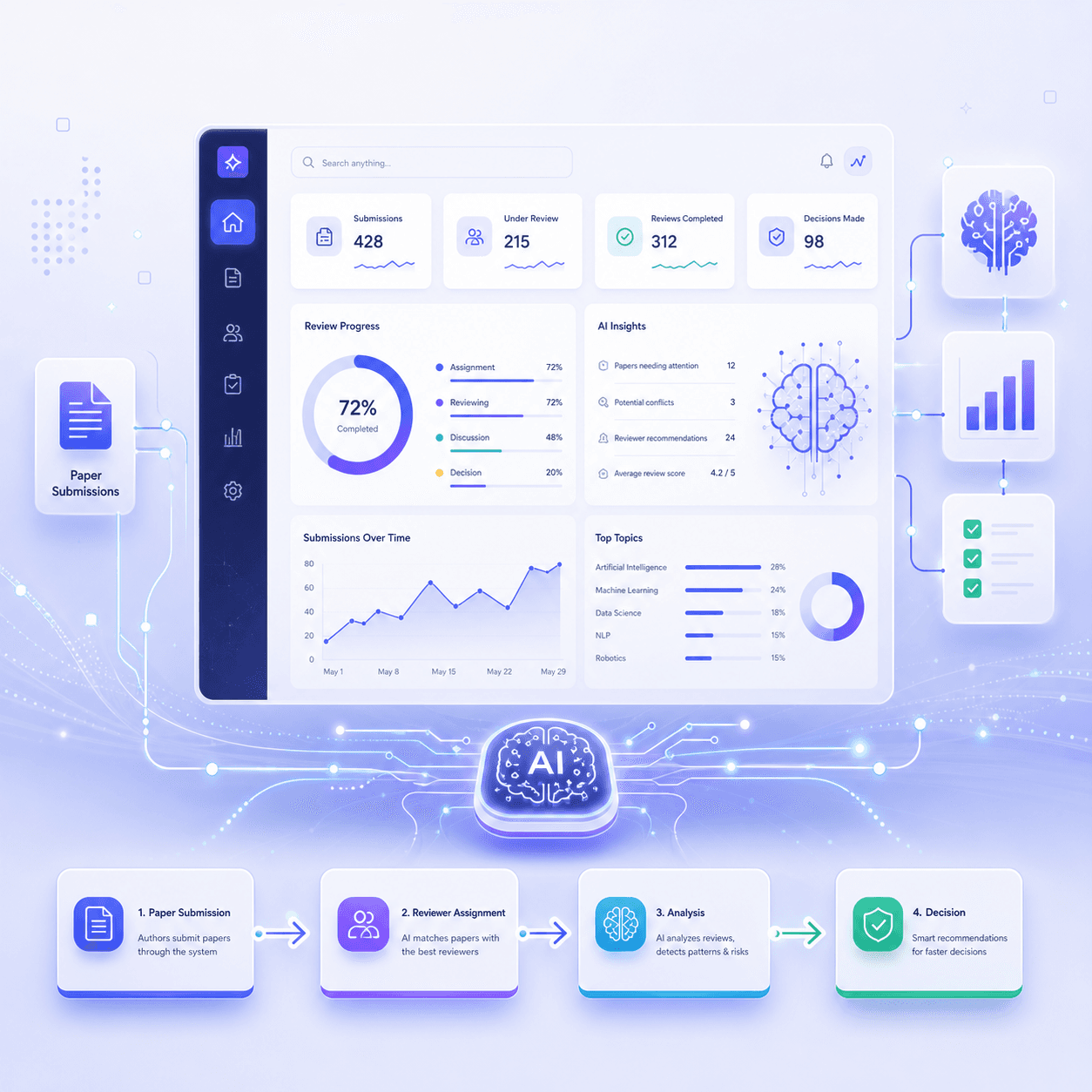
Today, AI features are typically integrated as discrete tools — a summarization button here, a matching algorithm there. The next evolution is end-to-end AI-assisted workflows where AI analysis flows seamlessly through every stage of the conference lifecycle. A paper is submitted → AI generates a summary and similarity report → the system suggests optimal reviewer assignments → reviewers receive AI-generated pre-analysis alongside the paper → the program committee reviews aggregated AI insights during decision meetings. Each stage builds on the previous one, creating a compound intelligence effect that's far more powerful than any individual AI feature.
Predictive Quality Analytics
As AI systems accumulate data across multiple conference cycles, they'll begin to identify meta-patterns — which types of papers tend to have the highest review variance, which reviewer-paper matchings produce the most substantive feedback, which submission characteristics correlate with post-publication impact. This predictive layer could help organizers proactively improve their conference quality year over year, rather than reacting to problems after they occur.
Personalized Reviewer Guidance
Future AI systems could provide reviewers with personalized guidance tailored to their specific expertise profile and the paper they're evaluating. Rather than a generic review form, a reviewer might receive targeted prompts: "This paper's methodology is closely related to [recent publication] — consider whether the comparison is adequate." This kind of context-aware guidance could significantly improve review quality across the board.
Multi-Language Support
Academic research is a global endeavor, but most conference management tools — and most AI models — are optimized for English. Future AI capabilities will include robust support for multilingual submissions, real-time translation of reviews, and analysis models that are trained on diverse academic corpora spanning multiple languages and research traditions.
The trajectory is clear: AI will become as fundamental to conference management as word processing is to academic writing. Not because it replaces human judgment, but because it makes human judgment faster, better-informed, and more consistently applied. For a look at how modern tools are evolving to meet these demands, see our comparison of conference management tools in 2026.
Upgrade Your Conference Workflow
If you're still manually matching reviewers to papers, skimming hundreds of abstracts without structured support, and hoping that no submission slips through with undetected overlap — you're spending dozens of hours on work that AI can handle in minutes.
If the AI capabilities described in this article sound like what your conference needs, they're not hypothetical — they're available now.
Confairo is a modern conference management platform with integrated AI features designed specifically for academic workflows. The AI Paper Reviewer Assistant, Smart Reviewer Assignment, and Similarity Detection are built directly into the organizer and reviewer dashboards — no separate tools, no manual exports, no additional subscriptions.
Every AI feature is designed as a decision-support tool: it provides structured analysis, quantified insights, and actionable recommendations — while keeping the final decision exactly where it belongs, with human experts.
Whether you're managing 30 submissions or 3,000, Confairo's AI capabilities scale with your conference — giving your organizing committee the analytical power of a much larger team without the overhead.
Set up your next conference with AI-powered workflows and see the difference for yourself.

Written by
Adnan Momin
Founder & Lead Developer
LinkedInAdnan Momin is the founder of Confairo, building tools that simplify conference management for academics worldwide.
Start managing your conferences with Confairo
From paper submissions to certificate generation — automate your entire conference workflow and save dozens of hours.

