

10 Common Mistakes in Academic Conference Management (And How to Avoid Them)

Introduction
Let's be honest — organizing an academic conference can feel like trying to land a plane while still building it. You're juggling paper submissions, reviewer assignments, communication with authors, scheduling sessions, generating certificates, and handling payments — all at the same time. And more often than not, you're doing it with a patchwork of spreadsheets, email threads, and browser tabs that would terrify any project manager.
If this sounds familiar, you're not alone. Every year, thousands of conference organizers — from first-time workshop chairs to seasoned program committee veterans — fall into the same predictable traps. The deadlines slip. The emails pile up. The reviewer who promised to finish "by Friday" goes radio silent. And somewhere in a shared Google Drive, there's a submissions spreadsheet with three conflicting versions.
The worst part? Most of these problems are entirely avoidable. They're not caused by bad intentions or lack of effort — they're caused by outdated workflows, fragmented tools, and a reliance on manual processes that simply don't scale when you're managing 50, 100, or 500 submissions.
In this article, we'll walk through the 10 most common mistakes in academic conference management, explain why each one happens, and — more importantly — show you exactly how to avoid them. Whether you're organizing a small departmental symposium or a large international conference, these lessons will save you time, stress, and more than a few late-night email sessions.
Quick Summary
- Using email for paper submissions creates chaos at scale
- Poor reviewer assignment leads to low-quality reviews and missed deadlines
- Without deadline tracking, cascading delays are inevitable
- Manual certificate creation wastes hours and introduces errors
- Using five separate tools instead of one centralized system causes data fragmentation
- Poor communication with authors and reviewers leads to confusion and frustration
- Ignoring payment management creates financial headaches
- Overcomplicated workflows burn out organizers and committee members
- Lack of automation means doing the same repetitive tasks hundreds of times
- No proper scheduling leads to conflicts, empty rooms, and frustrated attendees
10 Common Mistakes in Academic Conference Management
Mistake 1: Using Email for Paper Submissions
The scenario: Your Call for Papers says "Submit your paper to conference2026@gmail.com with the subject line: [Track]-[PaperTitle]-[AuthorName]." Sounds simple enough. Then the submissions start rolling in — and half of them have the wrong subject format, three are sent to the wrong email, one author sends four revisions in separate threads, and you spend your Tuesday night downloading 87 PDF attachments into a folder while cross-referencing a spreadsheet.
Why it's a problem: Email was never designed to be a submission management system. There's no version control, no automatic confirmation, no structured metadata capture, and no way to track the status of each submission at a glance. As submission volume grows, the inbox becomes unmanageable, and the risk of losing or duplicating a paper increases dramatically. Authors also have no way to check whether their submission was received successfully, leading to a flood of "Did you get my paper?" follow-up emails.
How to avoid it: Use a dedicated submission portal that accepts file uploads, captures metadata (title, abstract, authors, keywords) through structured forms, and sends automatic confirmation emails. A proper submission system gives you a real-time dashboard of all submissions — no inbox archaeology required. Modern platforms like those covered in our conference management guide eliminate this problem entirely.
Mistake 2: Poor Reviewer Assignment
The scenario: You have 120 submitted papers and a pool of 40 reviewers. You start assigning papers manually — matching keywords from abstracts to reviewer profiles, trying to remember who has expertise in NLP versus computer vision, avoiding conflicts of interest, and somehow balancing the workload so no one gets stuck with 15 papers while others have 2. Three hours later, you're still at it, and you haven't even started checking for co-author conflicts.
Why it's a problem: Manual reviewer assignment is not just slow — it's unreliable. Mismatched assignments lead to reviewers evaluating papers outside their expertise, which results in shallow or uninformed reviews. Unbalanced workloads lead to reviewer fatigue and missed deadlines. Undetected conflicts of interest undermine the integrity of the entire review process. And when assignments need to change (a reviewer drops out, a conflict is discovered late), reorganizing the entire matrix becomes a nightmare.
How to avoid it: Use a system that supports keyword-based or expertise-based matching, automatic conflict-of-interest detection, and workload balancing. Some platforms offer bidding systems where reviewers indicate which papers they're qualified to review — dramatically improving match quality. The goal is to make the assignment process systematic rather than relying on the program chair's memory and a spreadsheet.
Mistake 3: No Deadline Tracking System
The scenario: Your conference has at least eight critical deadlines: abstract submission, full paper submission, reviewer acceptance, review deadline, decision notification, camera-ready submission, early-bird registration, and final registration. You've listed them all on the website — but there's no system to track progress against them. The review deadline passes, 30% of reviews are still outstanding, and you realize you need to send manual follow-up emails to 12 reviewers. Meanwhile, the camera-ready deadline is three days away, and half the accepted authors haven't been notified yet because the decisions were delayed.
Why it's a problem: Academic conferences operate on cascading timelines — each deadline depends on the one before it. When the review deadline slips by a week, every subsequent milestone shifts too: decision notifications are delayed, camera-ready deadlines get compressed, and the schedule gets finalized at the last minute. Without automated tracking and reminders, the organizer becomes a full-time deadline enforcer — sending nudge emails, checking spreadsheets, and mentally tracking who has completed what.
How to avoid it: Set up automated deadline reminders that trigger at configurable intervals (e.g., 7 days before, 3 days before, 1 day before, and on the day). Use a dashboard that shows real-time progress — how many reviews are complete, how many are pending, who is overdue. This transforms deadline management from a manual, stressful process into a system that manages itself.
Mistake 4: Manual Certificate Creation
The scenario: The conference is over. It went well. Now you need to create certificates for 150 presenters, 200 attendees, 40 reviewers, and 5 best-paper awardees. You open Canva, create a template, and start typing names. One by one. Copy, paste, adjust the line spacing because "Dr. Muhammad Abdullah Al-Rashidi" doesn't fit in the same text box as "Li Wei." Export as PDF. Rename the file. Two hours later, you're on certificate #47 and someone messages you: "Hey, you misspelled my name on the certificate."
Why it's a problem: Manual certificate generation is one of the most tedious and error-prone tasks in post-conference logistics. It's not technically difficult — it's just mind-numbingly repetitive. And repetition breeds errors: typos in names, wrong paper titles, missing affiliations, inconsistent formatting. For a conference with 300+ participants, this can easily consume an entire day (or more) of an organizer's time. It's also a terrible look when a participant receives a certificate with their name misspelled — especially when they plan to include it in their academic portfolio.
How to avoid it: Use template-based automated certificate generation. Design your certificate template once, map it to participant data (name, paper title, role), and generate all certificates with a single click. Modern conference management platforms can produce hundreds of personalized PDF certificates in seconds — with zero typos, because the data comes directly from the registration and submission system.
Mistake 5: No Centralized System
The scenario: Your submissions are in EasyChair. Your registration data is in a Google Form. Your reviewer assignments are tracked in an Excel spreadsheet. Your schedule is in another spreadsheet. Your certificates are designed in Canva. Your payment tracking is in yet another spreadsheet. Your communication history is scattered across Gmail, WhatsApp, and a shared Google Drive. You need to find out whether Dr. Patel submitted their camera-ready paper, paid their registration fee, and confirmed their presentation slot — and the answer requires opening four different tools.
Why it's a problem: When your conference data lives in five or more disconnected systems, you have no single source of truth. Every piece of information requires cross-referencing between tools, manually copying data from one platform to another, and praying that nothing falls through the cracks. This fragmentation doesn't just waste time — it creates data inconsistencies. Maybe the registration spreadsheet says Dr. Patel paid, but the EasyChair system still shows their paper as "pending." Which one is correct? You won't know until you dig through email threads.
How to avoid it: Consolidate your conference management into a single, integrated platform that handles submissions, reviews, scheduling, registration, payments, and certificates in one place. When all your data lives in one system, you can answer any question about any participant in seconds — not minutes. This is where modern all-in-one platforms provide a transformative advantage over the traditional patchwork approach.
Mistake 6: Poor Communication with Participants
The scenario: An author submits their paper and hears nothing for six weeks. They email you asking for a status update. You respond. Three weeks later, they email again asking when reviews will be ready. You respond again. Meanwhile, a reviewer emails asking what format the review should be in. Another reviewer asks where to submit the review. An attendee asks about registration. A committee member asks about the schedule. Your inbox has 340 unread emails, and it's only Tuesday.
Why it's a problem: Lack of proactive communication creates anxiety for participants and an overwhelming support burden for organizers. When authors don't know the status of their submission, they assume the worst. When reviewers don't get clear instructions, they either do a poor job or don't do it at all. When attendees can't find basic information, they email you — and every email you answer manually is time you're not spending on actually running the conference. Poor communication also damages your conference's reputation. Participants remember the experience, not just the papers.
How to avoid it: Set up automated notifications for every key event in the conference lifecycle: submission confirmation, review assignment, deadline reminders, decision notifications, camera-ready instructions, and registration confirmation. Use a system with built-in email templates that trigger automatically based on status changes. This ensures every participant stays informed without the organizer writing a single email manually.
Mistake 7: Ignoring Payment Management
The scenario: Your conference charges a registration fee. You set up a bank account and ask participants to make direct transfers with their name and paper ID as reference. The payments start coming in — but half of them have incorrect references, three are in the wrong currency, two are duplicates, and one transfer shows a name you don't recognize. You spend hours cross-referencing bank statements with your registration spreadsheet, sending "Did you pay?" emails, and handling refund requests for people who registered but can't attend anymore.
Why it's a problem: Financial management is the most underestimated part of conference organization. Many organizers treat payments as an afterthought — "we'll figure it out" — and then spend disproportionate time on manual reconciliation. Without proper payment tracking, you can't confirm who has actually completed registration, you can't issue receipts automatically, and you can't generate financial reports for your institution. It's also a compliance issue — many universities require proper documentation for conference funds.
How to avoid it: Use integrated payment processing that links directly to your registration system. An online payment gateway (credit cards, UPI, bank transfers) with automatic receipt generation eliminates the reconciliation nightmare. Participants pay, the system records it, marks their registration as complete, and sends a receipt — all without organizer intervention. If your platform handles payments natively, you also get financial dashboards showing collected amounts, pending payments, and refund status in real time.
Mistake 8: Overcomplicated Workflows
The scenario: You've set up your conference with a seven-stage review process: initial screening, plagiarism check, reviewer bidding, first-round review, author rebuttal, second-round review, and meta-review. Each stage has its own forms, deadlines, and approval gates. It sounds thorough on paper — but your committee of five volunteers is drowning. The bidding phase alone took two weeks. The rebuttal system confused half the authors. And now you're debating whether the second-round reviews should be blind or open, while the conference is three weeks away and the schedule isn't started.
Why it's a problem: Complexity is not the same as quality. Many organizers — especially those running their first major conference — over-engineer the review process because they want it to be "rigorous." But an overcomplicated workflow doesn't make the conference better; it makes it harder to manage, slower to complete, and more likely to break down. Your reviewers are volunteers with their own research deadlines. Every additional step you add reduces the likelihood that they'll complete their reviews on time. Simplicity with clear structure beats complexity every time.
How to avoid it: Start with the simplest workflow that meets your quality requirements. For most conferences, this means: submit → assign reviewers → collect reviews → make decisions → notify authors. Add complexity only where it's genuinely needed (e.g., a rebuttal phase for a competitive, top-tier conference). Use a platform that makes it easy to configure your workflow without over-engineering it — one that provides sensible defaults rather than forcing you to build everything from scratch.
Mistake 9: Lack of Automation
The scenario: It's 11 PM. You've just finished manually sending 87 "Review Reminder" emails to your reviewer pool. Before that, you spent 45 minutes updating the submission status spreadsheet. Tomorrow, you need to manually export the accepted papers list, cross-reference it with the payment spreadsheet, draft individual acceptance letters, and send personalized camera-ready instructions to each author. You've done all of this before — for the abstract deadline, the full-paper deadline, and the review deadline. Each time, it takes hours. Each time, you wonder: "Isn't there a tool that does this automatically?"
Why it's a problem: Repetitive manual tasks are the silent time-killer of conference management. Individually, each task seems small — sending an email, updating a status, generating a report. But cumulatively, these tasks consume an enormous portion of the organizer's time. Worse, they introduce human error. A copy-paste mistake in an email, a missed cell in a spreadsheet, a forgotten notification — each small error can cascade into bigger problems. And the mental burden of tracking dozens of manual tasks across weeks or months leads to burnout.
How to avoid it: Automate everything that can be automated. Submission confirmations, review reminders, deadline alerts, decision notifications, status updates, payment receipts, and certificate generation — all of these should happen automatically based on triggers and rules, not manual effort. The ROI of automation is massive: what takes an organizer hours to do manually can be handled by a well-configured system in seconds. This is perhaps the single biggest advantage of using a purpose-built conference management platform over a collection of generic tools.
Mistake 10: No Proper Scheduling System
The scenario: You have 60 accepted papers across three parallel tracks. You open a blank Excel spreadsheet and start slotting papers into time blocks. Thirty minutes in, you realize you've scheduled Dr. Kim for two presentations in parallel sessions at 2:00 PM. You fix that, but now the morning session on Machine Learning has five papers and the afternoon session on NLP has only two. You try to rebalance, but every change creates a new conflict. The keynote speaker can only present on Day 2 morning, which pushes the poster session to an overlap with lunch. Two hours later, the spreadsheet is a rainbow of color-coded chaos, and you still don't have a workable schedule.
Why it's a problem: Conference scheduling is a constraint satisfaction problem — and it's much harder than it looks. You need to balance multiple variables simultaneously: session themes, speaker availability, room capacities, parallel track coordination, break times, keynote slots, and attendee interest patterns. Doing this manually in a spreadsheet is not just slow — it's error-prone. Scheduling conflicts (same speaker in two rooms, unbalanced sessions, overlapping events) are embarrassing when they make it into the published program and create real logistical problems on the day of the event.
How to avoid it: Use a visual schedule builder that lets you drag and drop papers into sessions, automatically detects conflicts (same speaker scheduled in parallel), and helps you balance session sizes. Some platforms offer smart scheduling that suggests optimal paper groupings based on topics and constraints. Even a basic scheduling tool is dramatically better than a raw spreadsheet — because it enforces constraints that a spreadsheet can't.
The Pattern Behind These Mistakes
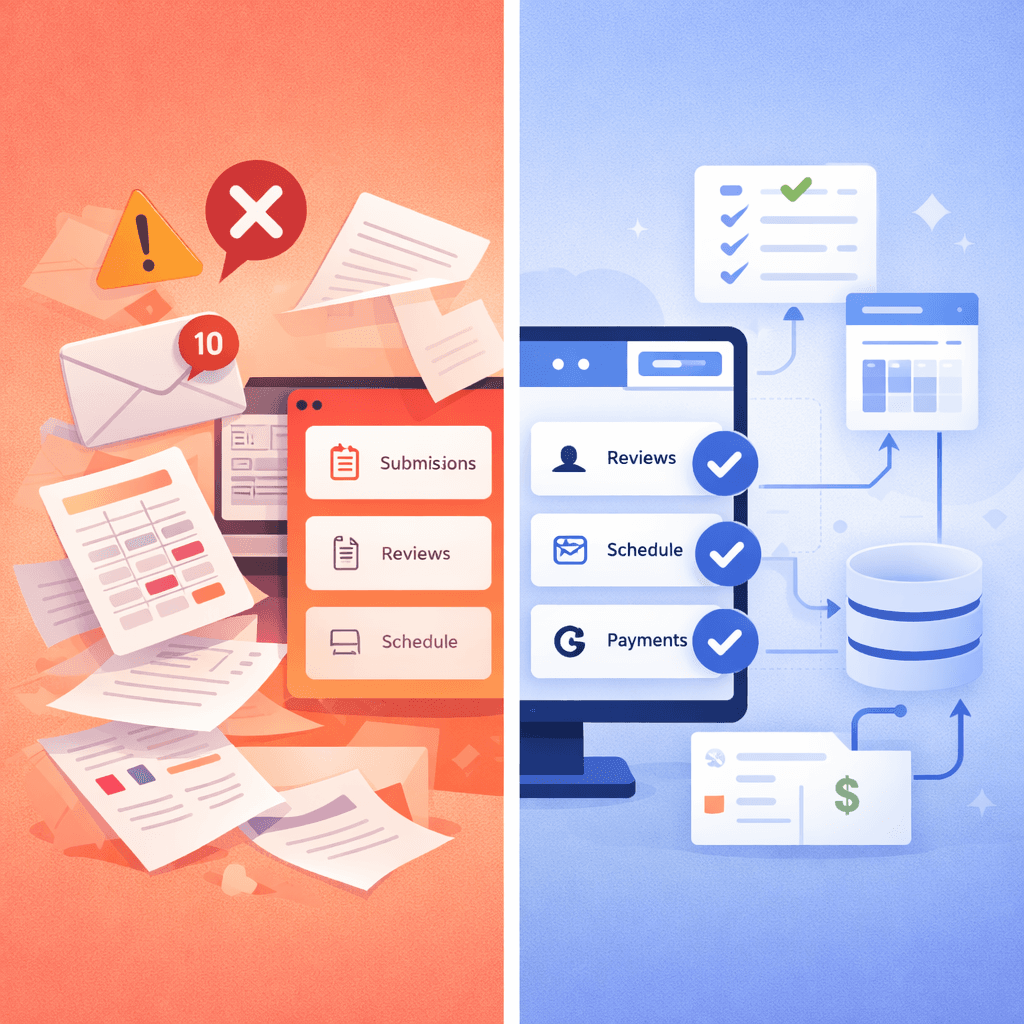
If you read through all ten mistakes, you'll notice a clear pattern: most of these problems are symptoms of the same root cause — fragmented, manual workflows using tools that weren't designed for conference management.
Email isn't a submission system. Excel isn't a scheduling engine. Canva isn't a certificate automation tool. Google Forms isn't a review management platform. Each of these tools is excellent at what it was built for — but none of them was built for running an academic conference.
When organizers stitch together five or six general-purpose tools, they become the integration layer. They're the ones copying data between systems, sending manual notifications, reconciling spreadsheets, and tracking deadlines in their heads. Every gap between tools is a point of failure — and every manual step is an opportunity for human error.
The solution isn't to work harder. It's to work with the right tools.
Simplify Your Conference Workflow
If these mistakes feel painfully familiar, you're not alone — and you don't have to keep managing conferences this way.
Confairo is a modern conference management platform built specifically for academic conferences. It brings everything into one place: paper submissions, peer review management, scheduling, registration with integrated payments, and automated certificate generation.
Instead of juggling email inboxes, spreadsheets, and five separate tools, you get a single dashboard where every aspect of your conference is organized, automated, and trackable.
- Submissions: Structured portal with automatic confirmation and metadata capture
- Reviews: Reviewer assignment, tracking, and automated reminders
- Scheduling: Visual schedule builder with conflict detection
- Payments: Integrated payment processing with automatic receipts
- Certificates: Template-based generation for hundreds of participants in one click
Set up your conference in minutes — not days. Eliminate the manual work that burns out organizers and frustrates participants.

Written by
Adnan Momin
Founder & Lead Developer
LinkedInAdnan Momin is the founder of Confairo, building tools that simplify conference management for academics worldwide.
Start managing your conferences with Confairo
From paper submissions to certificate generation — automate your entire conference workflow and save dozens of hours.
More from Confairo Blog
Continue exploring related articles
 Conferences
How to Manage Academic Conferences Efficiently (Complete Guide 2026)
A complete step-by-step guide for organizers — from call for papers to certificate generation. Learn modern workflows, AI automation, and how to eliminate conference management chaos.
 Conferences
Top 10 Academic Conference Management Tools in 2026 (Compared)
Compare the best academic conference management tools in 2026 — features, pros & cons, and find the right platform for your next conference.
 Conferences
Manual vs Automated Conference Management: Which One Should You Choose?
Caught between spreadsheets and software? This in-depth guide compares manual and automated conference management side by side — so you can make the right call before your next CFP goes live.

